Search This Blog

Table of Contents

Showing posts with label steve blank. Show all posts

What is a Startup Business?

11:01 AM No comments :
Before we start to talk about what a startup business is, lets talk about why it is important to define it.


Define a startup

Definitions are tricky, because they often exclude examples one wishes to include, and they include examples that one wishes to include.

Relying on commonplace assumptions about a set of features will lead to absurd claims as to what constitutes a startup.

What isn't a startup?


The commonplace idea of a startup is a new business, but there is a myth around the startup. Eric Ries in What's a startup? describes the mythology of the startup in the following terms:

What all of these pictures have in common is a narrative that goes something like this: scrappy outsiders, possessed of a unique genius, took outrageous risks and worked incomprehensible hours to beat the odds. (Ries)

But a new business, even a risky one, and hard working founders fall short of the definition of startup. The great counter example here would be the restaurant. Restaurants are risky, and require people to work "incomprehensible hour", but there seems to be wide agreement that a restaurant is not what people mean by a startup. Paul Graham uses it in his essay Startup=Growth, as an example of what is not, in his terms, a startup:

Millions of companies are started every year in the US. Only a tiny fraction are startups. Most are service businesses—restaurants, barbershops, plumbers, and so on. These are not startups, except in a few unusual cases. (Graham)

Peter Thiel also uses the restaurant business as a counter-example in his essay Competition Is for Losers:

Imagine you're running one of those restaurants in Mountain View. You're not that different from dozens of your competitors, so you've got to fight hard to survive. If you offer affordable food with low margins, you can probably pay employees only minimum wage. And you'll need to squeeze out every efficiency: That is why small restaurants put Grandma to work at the register and make the kids wash dishes in the back. (Peter Thiel)

Note that Thiel isn't explicitly talking about the definition of a startup, but is rendering advice.
Definitions and advice

Implicit in the definition of a startup is a normative claim about what you ought to do as a startup. When Graham talks about growth as definitive of a startup, he follows up to tell us that you should do what you can to grow a startup. When Thiel advises startups to produce a large innovation that takes us from "0 to 1", he implies that a startup, as opposed to say a restaurant, is a company that engages in an attempt to go from "0 to 1."

There isn't one main definition of a startup, but there are some key practitioners and theorists in the field who have come up with influential definitions. They happen to be men but if a reader has women to suggest, I will gladly add them to this list. They are many important and influential women in the field, but I haven't come across a definition of startups from them.

Here are some of the people from the "Seminal Essays" section.

 Paul Graham


Paul Graham: A startup is a company designed to grow fast. Being newly founded does not in itself make a company a startup. Nor is it necessary for a startup to work on technology, or take venture funding, or have some sort of "exit". The only essential thing is growth. Everything else we associate with startups follows from growth. (Graham)

This is from Paul Graham's essay "Startup=Growth".


Marc Andreesen


The only thing that matters is getting to product/market fit. (Andreesen)

This is from Marc Andreesen on the Product Market fit.


Peter Thiel


All happy companies are different: Each one earns a monopoly by solving a unique problem. All failed companies are the same: They failed to escape competition. (Thiel)

From Peter Thiel's Competition Is for Losers.


Steve Blank


Steve Blank: a startup is an organization formed to search for a repeatable and scalable business model. (Blank)

From Steve Blank on what's a startup.


Eric Reis


A startup is a human institution designed to deliver a new product or service under conditions of extreme uncertainty. (Reis)

from Eric Reis' on What is startup.


Steve Blank, What's A Startup?

6:59 PM No comments :
This is a discussion of Steve Blank's impressively succinct essay What's A Startup?. It is part of a series of discussions of foundational texts on What is a startup business?

You can buy his book, The Startup Owner's Manual here:

Steve Blank


Blank is known primarily as a theoretician, although he has founded and advised many companies. His ideas have been very influential in the culture.

What's A Startup?


Blank has been thinking about startups for a while, so his blog post are focused, but peppered with reference to other areas where he expands on the topic.

He gets right to the point:
In this post we’re going to offer a new definition of why startups exist: a startup is an organization formed to search for a repeatable and scalable business model. (Blank)
And then he unpacks the idea of a business model.

A business model describes how your company makes money. (Blank)
So a startup is an organization formed to search for a repeatable and scalable way to make money. That sounds like any business. What sets Blank's theory apart is probably the detailed process he lays out to form such a business.

Q: Peter Thiel seems to disagree with Blank's model. In particular he advises startups to have big bold plans, that can be modified indefinitely, which deliver an enormous innovation that earns a monopoly. Blank doesn't think this contradicts his own view. Do readers think there is a fundamental distinction here?

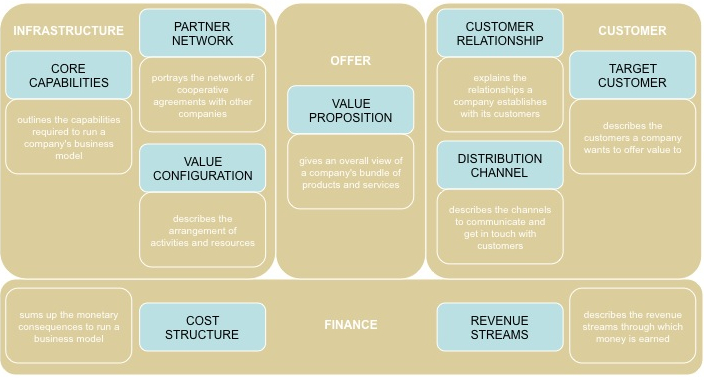
The Business Model Canvas


Blank is a fan of the Alexander Osterwalder's Business Model Canvas , which is a template to organize the components of a business.

https://steveblank.files.wordpress.com/2010/01/osterwalder-business-model.jpg

Startup as hypothesis testing


Blank has specific advice on the role of a founding team.
Your job as a founder is to quickly validate whether the model is correct by seeing if customers behave as your model predicts. Most of the time the darn customers don’t behave as you predicted. (Blank)
The benefit of this advice is it focuses energies on hypothesis testing early on.

Contrast: Although Thiel has claimed that this advice contradicts to come up with a long term plan, the tenure of the plan doesn't seem to be a central component of Blank's thesis. There is something about the MVP that feels small and timid, compared to Thiel's idea of going from 0 to 1 which feels ambitious and large in scale. The question is, if Blank had used a different word -- Initial Hypthesis Product, for instance -- would there still be a fundamental disagreement?

Q: Blank realizes of course that experimentation can be very expensive. You can't usually launch an entire business to see if customers like it, so his idea is to put out a really simple minimal viable product and use that to test it.

The big criticism -- and I am not the first to make it -- is this contrast directly with advice from other people.

Famously, Steve Jobs said in an interview:
"It's not about pop culture, and it's not about fooling people, and it's not about convincing people that they want something they don't. We figure out what we want. And I think we're pretty good at having the right discipline to think through whether a lot of other people are going to want it, too. That's what we get paid to do.
"So you can't go out and ask people, you know, what the next big [thing.] There's a great quote by Henry Ford, right? He said, 'If I'd have asked my customers what they wanted, they would have told me "A faster horse." ' "(Steve Jobs)
This is not the first time Jobs had said this.

Blank is well aware of this criticism, but I don't know that he fully takes on the problem.


You can buy his book, The Startup Owner's Manual here: